WINDING UP IN MALAYSIA: A GENERAL OVERVIEW
Updated: Jul 7
INTRODUCTION
Winding up, also known as liquidation, is often described as a “death sentence” of a company.[1] This is because, a process of winding up a company results in its closure, with all assets being sold or liquidated to pay off debts. Any remaining proceeds are then distributed to the contributories i.e. mainly the shareholders.
BACKGROUND
There are two processes for a company to be wound up in Malaysia (i.e. voluntary winding up and compulsory winding up). Both processes are governed by both the Companies Act 2016 (hereinafter referred to as “CA 2016”) and the Winding Up Rules 1972 (hereinafter referred to as “WUR 1972”).
Due to COVID-19 and government efforts to reduce the economic impact on companies, we have seen declining rates of companies being wound up from 2019 to 2021. This is mainly due to the raise of the threshold sum of indebtedness to commence compulsory winding up from RM10,000.00 to RM50,000.00 in the duration from 23rd April 2020 to 31st December 2020 which was made permanent by the Minister charged with the responsibility of companies on the 2nd March 2021 via Gazette No. 4159 of 2021.
In fact, it was reported by the Malaysian Department of Insolvency (hereinafter referred to as “MDI”) that from 2018 to February 2025, the total number of winding up cases is 17,999 (consists of 10,295 compulsory winding up cases and 7,704 voluntary winding up cases) and more than 99% of the cases thereof were due to inability to pay its debts.
[1]Conweld Engineering Sdn Bhd & Ors v. Goh Swee Boh @ Goh Cheng Kin & Anor [2019] MLJU 1359.

With the substantial number of both voluntary and compulsory winding up cases in Malaysia every year, it is important for us to understand the processes for both voluntary and compulsory winding up. This article aims to provide general overview of the procedures for both voluntary and compulsory winding up in Malaysia.
VOLUNTARY WINDING UP
The director(s) of a solvent company may decide to voluntarily close their business operations by carrying out a Members’ Voluntary Winding Up (hereinafter referred to as “MVWU”). The general process of a MVWU is as follows:
STEP 1: Meeting of directors to make a written declaration of solvency.
The director or majority of directors must meet in order to make a written declaration of solvency to the effect that they have inquired into the affairs of the company and have formed the opinion that the company will be able to pay its debts in full within a period not exceeding twelve months after the commencement of the MVWU.[4]
STEP 2: Lodging the written declaration of solvency with the Companies Commission of Malaysia (hereinafter referred to as “SSM”).
The written declaration of solvency must be made five weeks before passing the resolution for the MVWU and should be lodged with the Registrar of SSM before the date in which notices of the meeting to propose the MVWU are sent out to the members.[5]
[4] Section 443 (1) and Section 443 (3) of the CA 2016.
[5] Section 443 (4) of the CA 2016.
STEP 3: Meeting of company members for the proposed MVWU and appointment of a liquidator.
The director(s) of the company must hold a meeting of the company’s members in order to pass a special resolution and/or a resolution pursuant to the company’s constitution for the company to be wound up.[6]
At the meeting, the company would also appoint one or more persons to act as liquidator(s) of the company to liquidate the company’s assets and to settle all its liabilities before the distribution of the excess to the members.[7]
STEP 4: Lodging of winding up resolution.
The resolution passed for the MVWU must then be lodged with the Registrar of SSM within seven (7) days of its passing and published in one widely circulated Malay-language newspaper and one widely circulated English-language newspaper within ten (10) days of its passing. [8]
STEP 5: The Liquidator takes over.
The appointed liquidator takes control of the company’s assets, collects debts owed to the company, settles its liabilities, and distributes any remaining assets among the members according to their rights.
Alternatively, if the Liquidator appointed for the MVWU is of the opinion that the company is unable to pay its debts within the period stated in the written declaration of solvency or if the company director(s) are unable to obtain the written declaration of solvency and are of the view that the company is insolvent, a company could be voluntarily wound up through a Creditors’ Voluntary Winding Up (hereinafter referred to as “CVWU”). The general process of a CVWU is as follows:
STEP 1: Meeting of company members to propose and consider the CVWU.
The director(s) of the company must hold a meeting of the company’s members to propose and pass a special resolution and/or a resolution pursuant to the company’s constitution for the company to be wound up via a CVWU.
[6] Section 439 (1) of the CA 2016.
[7] Section 432 (2) (a) of the CA 2016.
[8] Section 439 (2) of the CA 2016.
STEP 2: Creditor’s Meeting to be held on the same day and/or the next day of meeting to consider the CVWU.
The notice of the meeting of creditors (together with a statement showing the names of all creditors and the amount of their claim) is to be sent by post to the creditors simultaneously with the sending of the notices of the meeting of the company members to propose and/or consider the CVWU.[9]
The company shall also cause the notice of the meeting of creditors to be advertised at least seven (7) days before the date of the meeting in one widely circulated Malay-language newspaper and one widely circulated English-language newspaper.[10]
STEP 3: Creditors’ Meeting.
Chairperson of the creditors’ meeting would confirm if the meeting is convened at a time and place convenient to majority value of the creditors.
A company director appointed to attend the meeting would attend the meeting and disclose to the meeting the company’s affairs and the circumstances leading up to the proposed winding up.[11]
STEP 4: Nomination of the Liquidator.
The company and the creditors could at their respective meetings nominate a person to be the Liquidator and the Liquidator nominated by the creditors shall prevail.
If the creditors do not nominate a liquidator, the Liquidator nominated during the company meeting by the company members shall prevail.[12]
STEP 5: The Liquidator takes over
The appointed liquidator of the creditor takes control of the company’s assets, collects debts owed to the company, settles its liabilities, and distributes any remaining assets among the members according to their rights.
[9] Section 449 (3) of the CA 2016.
[10] Section 449 (4) of the CA 2016.
[11] Section 449 (6) and Section 449 (7) of the CA 2016.
[12] Section 450 CA 2016.
ANNUAL MEETINGS
If the winding up continues for more than one year the liquidator shall summon an annual meeting of the members of the company in the case of a MVWU.
In the case of a CVWU a meeting of creditors and a meeting of the members of company would be called.
Any such meetings would be summoned at the end of the first year from the commencement of the MVWU or CVWU of each succeeding year but not more than one (1) year in order to discuss the status of the winding up.[13]
FINAL MEETING AND DISSOLUTION
Once the affairs of the Company are fully wound up the liquidator shall prepare for an account showing how the winding up has been conducted and the properties of the company which have been disposed of and call for a meeting.
In the case of a MVWU a meeting of the members of company would be called.
In CVWU a meeting of members of the company and creditors would be called.
Notice of such meeting shall be published at least thirty (30) days before the date of the final meeting in one widely circulated Malay-language newspaper and one widely circulated English-language newspaper.[14]
After the meeting the liquidator shall lodge with the Registrar of SSM and with the Official Receiver a return of the holding of the meeting and of its date with a copy of the account attached to such return, within seven (7) days from the date of the meeting.”
On the expiration of (3) months after lodging of the return with the Registrar and with the Official Receiver, the company shall be dissolved.
COMPULSORY WINDING-UP
Compulsory winding-up and/or involuntary liquidation is the legal process to force a company to be dissolved and/or wound up by a court order. This process is initiated typically when the company is unable to pay its debts, but it can also be due to various other reasons outlined in the Section 465 of the CA 2016 as follows:
(i) SPECIAL RESOLUTION
If the company has passed a special resolution for it to be wound up by the court.
[13] Section 458 CA 2016.
[14] Section 459 (2) CA 2016.
(ii) FAILURE TO COMMENCE BUSINESS
If the company does not commence business within a year from its incorporation.
(iii) DEFAULTS IN LODGING STATUTORY DECLARATION
If the company fails to lodge a statutory declaration by a secretary or its director pursuant to Section 190 (3) of the CA 2016 in relation to its shares.
(iv) NO MEMBER
When the company has no member.
(v) INABILITY TO PAY DEBTS
A company is adjudged to be unable to pay its debts if it fails to satisfy a creditor’s demand for a sum exceeding RM 50,000-00 within three weeks.
(vi) DIRECTOR(S) ACTED IN THEIR OWN INTEREST
Where the director(s) have acted in the affairs of the company in their own interest rather than the interest of the members as a whole or in any manner that might be unfair to the members.
(vii) COMPANY CONSTITUTION
If the company’s constitution has provided that the company should be dissolved after a period of time or due to some occurrence.
(viii) JUST AND EQUITABLE GROUNDS
The court may order winding up if it believes it is just and equitable to do so, often in cases of deadlock or serious management issues.
(ix) OPERATING WITHOUT A LICENSE OR WITH AN EXPIRED/REVOKED LICENSE
Where the company is operating a licensed business without being duly licensed under the Financial Services Act 2013 and/or the Islamic Financial Services Act 2013 and or such license has expired or has been revoked.
(x) UNLAWFUL PURPOSE
The company is being used for an unlawful purpose or any purpose that is against peace, welfare, security, public interest, public order, good order or morality in Malaysia.
(xi) DECLARATION BY MINISTER
If the Minister has made a declaration to wind up the company pursuant to Section 590 of the CA 2016.
THE TOTAL NUMBER OF COMPULSORY WINDING UP CASES REGISTERED FROM YEAR 2018 TO JUNE 2025
The following statistics show the number of compulsory winding up cases according to the State/City, according to the business sectors, according to the status and nationality of the company concerned:
(i) BY STATE/CITY

Source: Malaysia Department of Insolvency
(ii) BY BUSINESS SECTOR

Source: Malaysia Department of Insolvency
(iii) BY STATUS AND NATIONALITY OF COMPANY
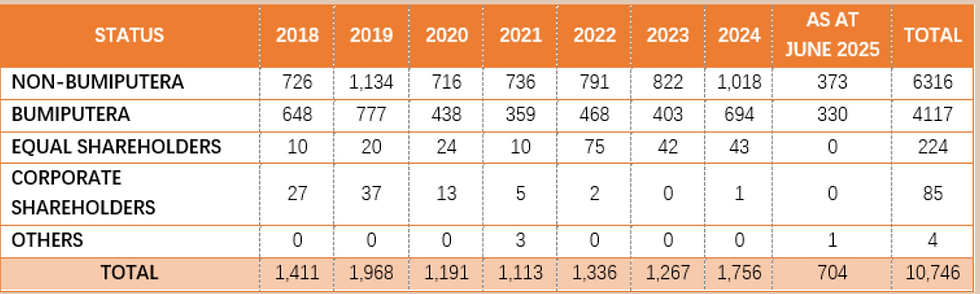
Source: Malaysia Department of Insolvency
PROCEDURE FOR COMPULSORY WINDING UP WHEN A COMPANY IS UNABLE TO PAY ITS DEBTS
The most common circumstance for an insolvent company to be wound up by a court order is its inability to pay its debts, usually proven by a final judgment and/or court order. The process for a compulsory winding up via a winding up petition for a company unable to pay its debts is as follows:
STEP 1: Service of final judgment and/or order.
The creditor who has obtained a final judgment and/or order against the company must serve it on the company.
Leave of court is required to present the winding up petition if it has already been six years since the date of the judgment. [15]
STEP 2: Statutory Notice of Demand.
A Statutory Notice of Demand demanding for a liquidated sum and/or judgment sum exceeding RM50,000-00 must be left at the registered office of the company.
STEP 3: Winding Up Petition and payment of deposit for the petition.
After twenty-one (21) days have lapsed and no payment has been made by the company, the creditor could present to the court a winding up petition in Form 2 (hereinafter referred to as “the Petition”).
The Registrar of the Court would then fix a hearing date for the Petition.
The petitioning creditor must deposit a sum of RM 3,000-00 with the Official Receiver (OR) [16].
[15] Dr Shamsul Bahar Abdul Kadir v RHB Bank Bhd [2015] 4 CLJ 561.
[16] Rule 23A WUR 1972.
STEP 4: Affidavit Verifying Petition.
An affidavit in Form 7 to verify the petition must also be filed within four (4) days after the petition is presented.
STEP 5: Serve the Petition and the Affidavit.
Both the Petition and the Affidavit Verifying Petition must be served on the company, the Official Receiver and the Registrar of SSM.
An Affidavit of Service must also be filed.
STEP 6: Advertise the Petition.
The Petition must then be advertised in Form 4, once in the government gazette and twice in two local newspapers seven (7) clear days before the hearing of the Petition.
STEP 7: Obtain a certificate of compliance.
Before the hearing of the Petition, the petitioning creditor must appear before the Senior Assistant Registrar of the High Court and satisfy the Court the requirements of the WUR 1972 have been complied with.[17]
STEP 8: Affidavit of Opposition and Affidavit in Reply.
A Company that wishes to oppose the Petition may file an Affidavit in Opposition within seven (7) days before the hearing of the winding up petition.
The Petitioner would then have a further three (3) days to present and serve their Affidavit in Reply to the Affidavit in Opposition.
STEP 9: Notice of Intention to Appear and List of Parties.
Every person(s) who intends to appear on the hearing of the Petition to support or oppose must file a Notice of Intention to Appear in Form 8 and must serve such notice at the address of the Petition/his solicitors before twelve (12) noon of the day before the hearing date. [18]
Pursuant to Rule 29(2) of the WUR 1972, the Petitioner must then file and serve to the Court the List of Parties that have served their Notice of Intention to Appear.
[17] Rule 32 WUR 1972.
[18] Rule 28 WUR 1972.
STEP 10: Hearing of the Petition.
The Court would then decide to grant the winding up order or dismiss it altogether.
In deciding if a company is able to meet its debts, the test of commercial solvency applied by the Court is dependent on whether or not it is able to meet its debts as they come due and not whether the current assets of the company if realised, will enable the company to meet the said debts.[19]
STEP 11: Granting of order and giving notice.
After the winding up order is granted and sealed by the Court, the notice of winding up in Form 12 must be gazetted and advertised.
Such notice must also be served on the Liquidator appointed, the Official Receiver, the Registrar of SSM and the company that has just been wound up.
STEP 12: The Liquidator takes over.
After a company is wound up, the liquidator takes control of the business, realises the company assets and distributes the proceeds of the same to the company’s creditors.
They are also responsible to call for any meeting of creditors and or the final meeting before the company is fully dissolved.
CONCLUSION
In Malaysia, both compulsory and voluntary winding up of a company involves a structured legal process aimed at settling debts and distributing remaining assets. Whether initiated voluntarily (i.e. via a MVWU or CVWU) or compulsorily through a court order, understanding the procedures and legal requirements is crucial for ensuring a smooth and efficient winding up process going forward especially in light of the growing number of winding up cases.

[19] Sri Hartamas Development Sdn Bhd v MBF Finance Bhd [1992] 1 MLRA 311.
DISCLAIMER: THE CONTENTS HEREIN ARE INTENDED FOR GENERAL INFORMATION ONLY AND NOT TO BE CONSTRUED AS LEGAL ADVICE. SHOULD YOU HAVE FURTHER QUERIES AND/OR WOULD LIKE TO HAVE THE FULL ARTICLE, KINDLY CONTACT US.


Comments